
 Subscription Pricing Strategies for Recurring Commerce: Freemium, Tiered, Usage-Based, and Hybrid
Subscription Pricing Strategies for Recurring Commerce: Freemium, Tiered, Usage-Based, and Hybrid
Choosing the right subscription pricing strategy is crucial for any business moving to recurring revenue. Beyond just setting a price, it means structuring how customers pay (and what they get) to maximize conversions and lifetime value.


A subscription business model is a revenue model in which customers pay a recurring fee, typically monthly or annually, to access a product or service, and it is taking over the world and your business and your household.
Don’t believe me? Check the recent news… using Tesla's Full Self-Driving (Supervised) software moved from a one-time fee to a subscription (source). Think about your Netflix or Amazon Prime account, MS Office or Google Workspace usage, National Geographic magazine subsription, Workwize or WeWork space team access, Spotify and ChatGPT account, a home office-as-a-service solution Nuwo takes, food delivery, Dollar Shave Club box surprise… even your Crystallize account!!!... all SUBSCRIPTIONS.
A simple reason for such immense adoption and popularity. Instead of just focusing on one-off sales like the old way, subscription models are all about building ongoing customer relationships. Businesses keep delivering value over time, and in return, customers pay regularly.
With the above being the case, we’d like to explore today's popular pricing models
Freemium vs. Paid,
Tiered Plans,
Usage-Based (Metered),
Flat-Rate vs. Hybrid models,
and One-Time vs. Subscription offerings
and help you decide which fits your product/service and market. We’ll also touch on why recurring subscription benefits (like predictable income and higher CLTV) often outweigh one-off sales, and how platforms like Crystallize support these models.
Which Subscription Pricing Model Fits Your Business?
The best subscription pricing strategy depends less on the billing model and more on what the customer is actually subscribing to: products, access, usage, service, convenience, or a combination of all of them.
Subscription type | Best pricing models | Why |
|---|---|---|
Physical product subscriptions | Flat-rate, tiered, prepaid, subscribe-and-save | Customers want predictability; merchants need inventory and delivery logic. |
Digital subscriptions | Freemium, free trial, tiered, annual discount | Access and perceived value matter more than shipping or inventory. |
Memberships | Tiered, annual, hybrid, perks-based pricing | Different member levels can unlock content, products, benefits, or community access. |
Bundled subscriptions | Tiered, curated box pricing, add-ons, mixed carts | Product relationships and box value need to be clear. |
B2B subscriptions | Contract pricing, usage-based, volume tiers, annual commitments | Pricing often depends on account size, usage, terms, or procurement rules. |
Content + commerce subscriptions | Hybrid, membership, product + access bundles | The value comes from both content and products, not billing alone. |
Freemium vs. Paid: Using Free Tiers or Trials to Drive Conversions
One proven strategy to attract users is the freemium model: offer a basic tier for free (or a free trial) and encourage users to upgrade to a paid plan for full features. A free entry point widens your funnel, letting customers try your service with minimal friction. Over time, as they find value, many convert to paying subscribers.
Dropbox, for example, famously used a freemium model: users receive basic storage at no cost and can upgrade to premium for additional storage and features. This broad free user base became a pipeline for paid conversions. Another example is Google Drive, which offers 15 GB of free storage; beyond that limit, users must subscribe to a larger storage plan. In both cases, the free tier showcases the product’s value and builds habit, increasing the likelihood that users will pay for more.
There are a couple of ways to implement freemium incentives:
- Free Tier (Permanent): A limited-but-usable version of your product that remains free. This is great for products where ongoing basic use can hook users. Ensure your free tier is genuinely useful but leaves power users wanting more (so they upgrade). The risk is managing the cost of free users; you’ll need enough conversions to justify supporting non-paying customers.
- Free Trial (Time-Limited): Offer the full product free for a short period (7, 14, or 30 days). This gives users a taste of the premium experience. It’s less about ongoing free value and more about reducing risk for the initial sign-up. Many SaaS companies use this to let users explore all features.
Whether you choose a permanent free tier or a trial, the goal is the same: convert curious users into loyal paying subscribers. Track your free-to-paid conversion rate (the percentage of free users who upgrade) as a key metric. And remember to market the added value that justifies going paid – be it more features, higher usage limits, or exclusive content.
Sometimes, it just makes more sense for a product to skip the whole freemium thing and go straight to paid-only subscriptions. That's usually the right move when your audience already gets the problem you're solving, or the value is obvious, and you can measure it right away. We talk some more about freemium vs. paid subscriptions.
For digital products or content-led subscriptions, pricing should connect access, content, and product data. That is where a flexible subscription commerce platform matters.
Tiered Pricing: Structuring Multi-Plan Options (Basic, Premium, etc.)
Tiered pricing means offering multiple subscription plans at different price points, each with a varying set of features or usage limits. This good-better-best approach lets you capture different customers and their willingness to pay. Examples are everywhere on the web. Most SaaS businesses use tiered pricing, either alone or in combination with a freemium entry level.
When creating tiers, consider the following:
- Differentiate Features Clearly: Each upgrade tier should offer noticeably more value – whether in quantity (more users, more projects, higher limits) or quality (premium features, faster support, exclusive content). For instance, a Basic SaaS plan might include only core features, while a Pro plan includes advanced analytics and integrations.
- Align Price with Value: The price jump from one tier to the next should feel justified. Users should see the higher tier as worth it for their needs. If the added benefits are too expensive, they’ll stick with lower plans (or leave). Conversely, if the higher tier is too cheap, you might be leaving money on the table.
- Encourage Upgrades: Design tiers so that growing customers naturally progress upward. Perhaps the Basic plan covers a small team, but as a customer’s team grows, they’ll need the Pro plan’s higher user limit. Upsell cues (like “Upgrade to Premium to get X”) within the product can remind users of what they’re missing.
Tiered models can also include an enterprise or custom tier (often labeled “Contact us for pricing”), which allows large clients to negotiate pricing for large-scale needs. This way, your pricing covers everything from entry-level to high-end without leaving anyone out.
From a technical standpoint, implementing tiered plans is straightforward with the right platform. In Crystallize, for example, you could define multiple subscription offerings or product variants tied to the same underlying subscription plan rules. Each variant (Basic, Premium, etc.) can have its own price and feature set, while sharing common infrastructure (billing periods, etc.).

Usage-Based (Metered) Pricing: Pay-As-You-Go Subscriptions
Another model gaining popularity, especially in SaaS and API products, is usage-based pricing (also called metered or pay-as-you-go). In this model, the customer’s bill is directly tied to how much of the service they consume. It’s a flexible approach: low-usage customers pay less, heavy users pay more. This can be attractive for customers because it aligns cost with value – you pay only for what you actually use.
Real-world examples of usage-based subscriptions are all around us. Many mobile phone plans charge a fixed monthly base fee that includes a certain amount of data/minutes, then add charges if you exceed those limits. In other cases, there’s no base fee at all – for instance, cloud APIs or developer platforms often charge purely by usage, meaning if someone uses zero resources in a month, they pay nothing; if they double their usage next month, the bill doubles accordingly.
Customers appreciate the model's fairness; your bill reflects your usage. This can lower the barrier to entry (no hefty flat fee for light users) and scale naturally with a customer’s growth. It’s especially useful for services where usage varies widely between customers. On the other hand, for businesses, as customers gain more value and use more, revenue from that customer increases proportionally. This can lead to very high customer lifetime value for those who grow significantly (they don’t need to jump to a new “plan” – they just use more).
Unlike fixed subscriptions, usage-based billing can fluctuate month to month. This makes revenue forecasting trickier. Also, if not communicated well, customers might be surprised by high usage bills. Mitigate this with clear dashboards, usage alerts, or caps. Often, companies combine usage pricing with tiered commitments or ceilings to provide some predictability (e.g., “up to X usage for $Y, then pay-as-you-go beyond”).
Implementing usage-based pricing is made easier with modern commerce platforms. For instance, Crystallize’s subscription engine supports metered variables to define usage-based billing rules. You can set a base price and add usage tiers. For example, you might configure a plan as “$100/month base + $5 per extra 1GB of bandwidth”. Crystallize lets you define these pricing tiers in two ways: volume-based (a single rate for all units once a threshold is reached) or graduated (incremental rates for each usage tier). This means complex models (such as a decreasing price per unit at higher volume) can be handled seamlessly. The platform will track each customer’s usage and calculate the billing amount accordingly, so you don’t have to build that from scratch.
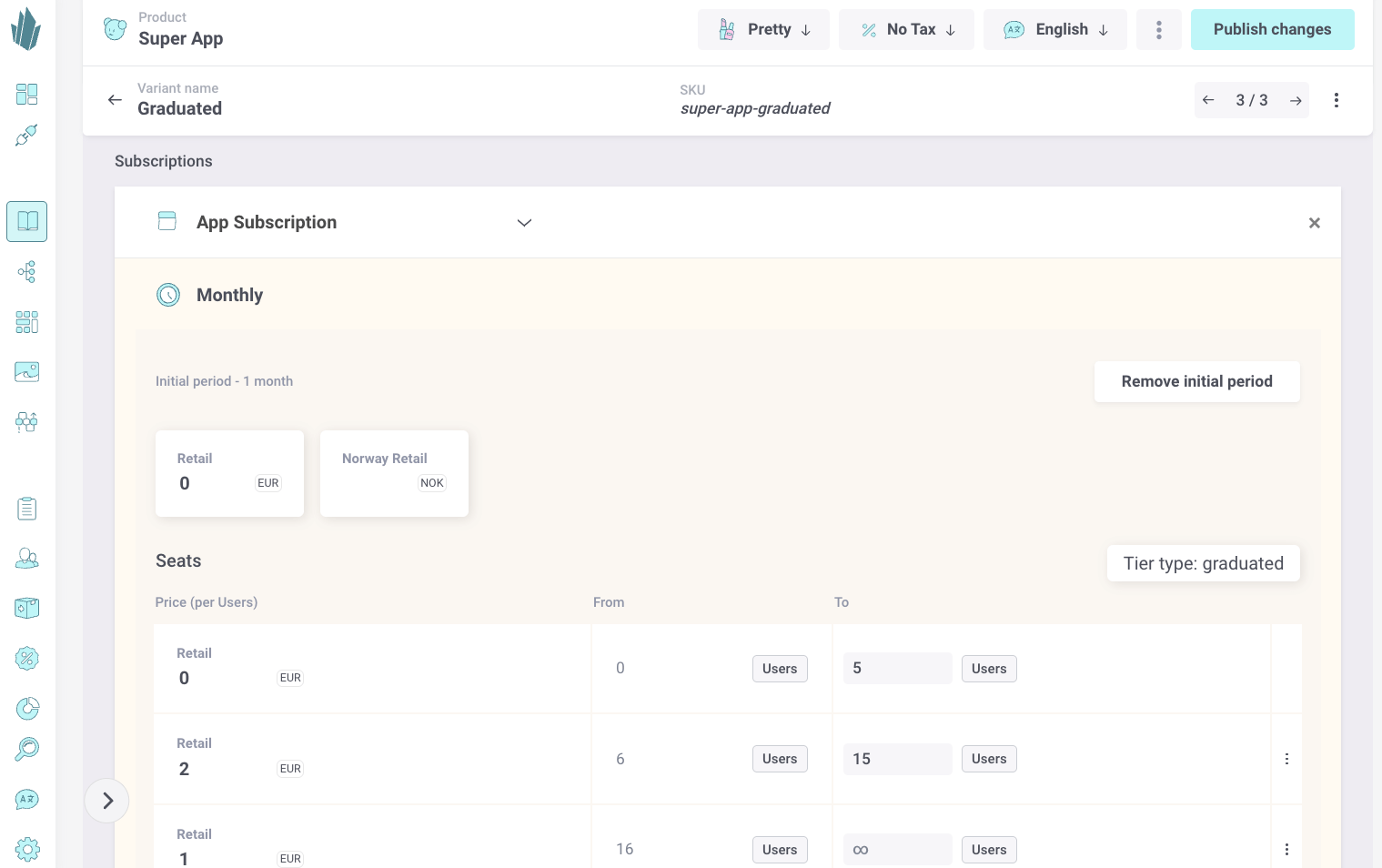
Usage-based subscriptions work best when your product’s value is closely tied to how much a customer uses it (e.g., API calls, storage, users, transactions). Just design the model to be fair and transparent, and ensure your infrastructure (and customers) can handle the dynamic nature of metered billing.
Usage-based pricing is powerful, but it needs transparency. Customers should understand what they are charged for, where usage is tracked, and when they are approaching limits.
Flat-Rate vs. Hybrid Pricing Models
When devising your pricing, a key question is whether to charge a flat rate (a single fixed fee for all use) or a hybrid model (combining a base fee with variable usage or add-ons). Both approaches have merits, and the right choice depends on your product economics and customer preferences.
Flat-Rate Subscription. This is the classic subscription – one price for essentially “all-you-can-use” service within normal parameters. Examples include most streaming services or software tools that don’t meter usage. Flat-rate pricing is simple and predictable: customers know exactly what they pay each period and receive a consistent set of benefits. Businesses like it because revenue is steady and easier to forecast.
However, a flat rate assumes an average usage; very high-usage customers might effectively get a bargain (potentially straining your costs), while very low-usage customers might feel they’re overpaying. Ensure your flat pricing is set so that heavy users remain profitable, and consider whether an “unlimited” model truly works for your service.
Hybrid Model (Base Fee + Usage/Add-Ons). A hybrid pricing strategy blends the two: customers pay a base subscription fee (which may include allowances or core features) and then pay extra for additional usage or optional add-ons. Many telecommunication plans use this: e.g., $50/month for a plan that includes 5GB of data, then $10 per extra GB if you go over. The base fee secures some predictable revenue, while the usage charge ensures you get compensated by power users who consume more than the norm. Another hybrid example is a SaaS platform that charges a base price for the software access but allows customers to buy one-time add-ons or extra modules for a fee.
The advantage of hybrid pricing is balance. Customers with typical usage receive a fixed price, while those with above-average needs pay more. It can also be a great way to monetize premium features: for instance, a base plan plus a paid add-on for advanced analytics, or a base membership plus paid access to special content.
When designing a hybrid model, be clear about what’s included in the base package and how additional usage or add-ons will be billed. Transparency is key; customers should understand their bill structure to build trust.
Finally, hybrid pricing is often the most practical ecommerce model because customers can subscribe to a core product or service, then add one-time purchases, upgrades, accessories, replacements, gifts, or seasonal products.
From an implementation perspective, and as shown in the Crystallize example, hybrid models are fully supported. As mentioned, you can set up subscription plans with both a base price and metered overage fees. You can also create one-time product variants for add-on purchases (for example, a one-time add-on product that subscribers can purchase in addition to their recurring plan). In Crystallize, you can even configure this by creating a subscription plan for the base service and separate SKUs for any one-time add-ons or upgrades.
One more thing to nail down is the right billing cycle—think monthly vs. annual subscriptions (or maybe weekly or quarterly). Our linked☝️ AI-enhanced terms decoder page has more details on that.
One-Time Purchases vs. Subscriptions (and Add-Ons)
Businesses often have to figure out a big question: Should they sell a product just once, or offer it as an ongoing subscription (or maybe both)? And if you're running a subscription, does it make sense to also sell one-time extras?
Offering a one-time purchase option vs. a subscription can make sense if your product delivers ongoing value over time but some customers might prefer a single upfront payment.
For example, consider software or digital services: you could sell a lifetime license at a premium price, or offer a subscription with a lower monthly fee that provides continuous updates. A perfect real-world example is in the automotive tech space, already mentioned Tesla's Full Self-Driving (Supervised) service move from a one-time fee to a subscription with a promise of ongoing access/improvements.
But when to offer one-time vs subscription? The easiest answer (and most true) is that it comes down to customer preference and the nature of the product.
If your product requires continuous updates, maintenance, or content delivery, subscriptions make more sense (e.g., a cloud software that’s always improving). Customers pay as they receive ongoing value. But you might still offer a one-time purchase option for those who prefer not to make recurring payments, perhaps without updates after a year.
If your product is a tangible item or a finite service, a one-time purchase is standard. Yet you could introduce a subscription around it (e.g., a one-time purchase of a device vs. a subscription that provides replacement parts or accessories over time).
A hybrid approach would be to offer both and let the market decide. An e-learning platform might allow students to purchase a course outright or subscribe monthly to access all courses. Just be careful to position them such that one doesn’t cannibalize the other in a way that harms your revenue. Often, the subscription is marketed as offering better ongoing value, while the one-time option offers premium convenience for those who prefer ownership.
Now, regarding one-time add-ons alongside subscriptions: These are optional, non-recurring purchases offered to your subscribers. Many successful subscription businesses do this to boost revenue and delight customers. Dollar Shave Club, for example, operates on a monthly razor subscription but allows subscribers to add or swap in extra grooming products in their monthly box. This flexibility increases customer satisfaction (they get exactly what they need) and increases average revenue per user (through cross-selling).
If you run a subscription e-commerce (say, a monthly curated box), you might offer one-time “add-on products” each cycle – subscribers can choose to buy an extra item that isn’t usually included. This can increase engagement and revenue. Crystallize supports this approach by allowing mixed carts (subscription and one-off items) and treating subscription plans as another product type in your catalog. For example, you could have a “Subscription Plan” product variant for recurring purchases and separate SKUs for one-time purchases, all managed under the same system.
👀Setting Up Subscription eCommerce with Crystallize
Wanna build a killer subscription commerce with a pricing model that elevates your growth? You'll need a slick frontend for users and some smart automation on the backend. This technical guide shows you how to set up a solid subscription eCommerce system using Crystallize, Next.js, and TypeScript.
We cover the entire customer journey: magic-link passwordless login, personalized subscription contracts, and a dedicated account area for order management. On the tech side, we dig into webhooks and automated pipelines to handle recurring billing, payment retries, and even manual intervention when a transaction fails.

Choosing the Optimal Pricing Model (and the Power of Recurring Revenue)
With so many models – freemium, tiered, usage-based, hybrid, one-off, etc. – how do you choose the right pricing approach for your business? The answer lies in understanding your market, product value, and customers’ behavior.
If your business depends on… | Start with… |
|---|---|
Predictable recurring product delivery | Flat-rate or tiered pricing |
Product volume or box size | Tiered pricing |
Customer usage | Usage-based pricing |
B2B accounts | Contract or volume pricing |
Digital access | Freemium, trial, or tiered access |
Content + products | Hybrid pricing |
Higher upfront cash flow | Annual or prepaid plans |
Increasing AOV | Add-ons and mixed carts |
Reducing churn | Pause/skip/swap flexibility + annual incentives |
Pick a model that fits how customers use your product, offer flexible billing like monthly and annual, and keep iterating; do that well, and subscriptions turn into long-term relationships instead of one-off transactions.
Let us show you how our subscription engine can help your business grow.
CLICK HERE and set up a personal 1-on-1 Crystallize demo. Let’s discuss your use case and take it from there.
Alternatively, why not SIGN UP for FREE, try Crystallize, and get our team's unparalleled support to help you get going.
🛟Dive!

Subscription eCommerce Platforms: Billing vs Add-Ons vs Headless
Broadly, subscription platforms fall into four categories: dedicated billing, ecommerce add-ons, subscription-first platforms, and headless commerce— each with its own strengths and fit for your business model.

How to Build Subscription eCommerce with Crystallize, Next.js, and TypeScript?
This tutorial shows how to build a subscription ecommerce flow with Crystallize, Next.js, and TypeScript: login, customer creation, subscription contracts, renewal orders, payment retries, and a customer account page.